The 60-Minute Golf Practice Routine That Transfers
In this guide
- Key takeaways
- Why doesn't hitting a big bucket improve your scores?
- What should the first 10 minutes do?
- How should you split the hour between block and random practice?
- What does a range session with real targets look like?
- How do you fit in putting when the range has no room?
- How do you end with a pressure test that feels like the course?
- How do you know if practice is transferring to the course?
- FAQ
A good 60-minute golf practice routine splits the hour 10/20/20/10: a 10-minute warm-up, 20 minutes of block practice on one fix, 20 minutes of random practice changing club and target every ball, and a 10-minute, 9-shot pressure test. The whole session uses about 85 balls, and the pressure-test score shows whether practice transfers to the course.
Key takeaways
- Split one hour 10/20/20/10: warm-up, block practice, random practice, pressure test. That's about 85 balls, one large bucket.
- Block practice grooves one fix with one club. Random practice, changing club and target every ball, is what carries over to the course.
- For every ball, note three things: strike, start line and where it finished. Take one fix into the next session.
- End every session with the same 9-shot pressure test, so your progress becomes one number you can follow.
- Expect the pressure-test score to move within two or three sessions, and your scorecard within about four weeks.
A range game that doesn't show up on the course needs structure, not more balls. Below is the minute-by-minute plan, how to split block and random work, a putting block, and how to tell whether the routine is working.
Why doesn't hitting a big bucket improve your scores?
Repeating the same shot feels good but isn't golf
Hitting 20 straight 7-irons at the same target is block practice: the same movement, repeated. Block practice feels productive and builds rhythm, but the course never asks for the same shot twice.
Motor-learning research on what's called contextual interference (going back to Shea and Morgan's 1979 study) found that practicing in a varied, random order makes you look worse during practice but remember skills better and use them better in new situations. The gap between how practice looks and what you retain is why your range swing disappears on the first tee.
Same bucket, same misses, same score
If you're stuck on a plateau, the bucket routine is often the reason: the same drills, the same misses, and nothing telling you what to work on next. A session with varied targets and one clear fix breaks the pattern. The other half is remembering that fix next time, which is what AimBox Golf AI is built for.
What should the first 10 minutes do?
A wedge to 7-iron ladder, no swing thoughts
Start with wedges at half speed and work up to a 7-iron. Hit every ball at a target, not the net. Skip the driver: swinging hardest while you're cold is how tweaks happen. No mechanics, no positions, no phone video. You're loosening a motion you already own, not fixing it.
The warm-up isn't practice time
If you're diagnosing misses in the first 10 minutes, you're judging a cold swing and the results don't mean much. When you finish, note one line: what felt loose, what felt solid. The real work then starts from that baseline.
How should you split the hour between block and random practice?
Split it 10/20/20/10. Block practice means repeating one shot with one club until the fix sticks. Random practice means changing club and target every ball.
The 10/20/20/10 template
| Block | Minutes | Balls | What you do |
|---|---|---|---|
| Warm-up | 10 | 15 | Wedge up to 7-iron, smooth tempo |
| Block practice | 20 | 30 | One fix, one club, one target |
| Random practice | 20 | 30 | New club and target every ball |
| Pressure test | 10 | 9 | Nine targets, scored |
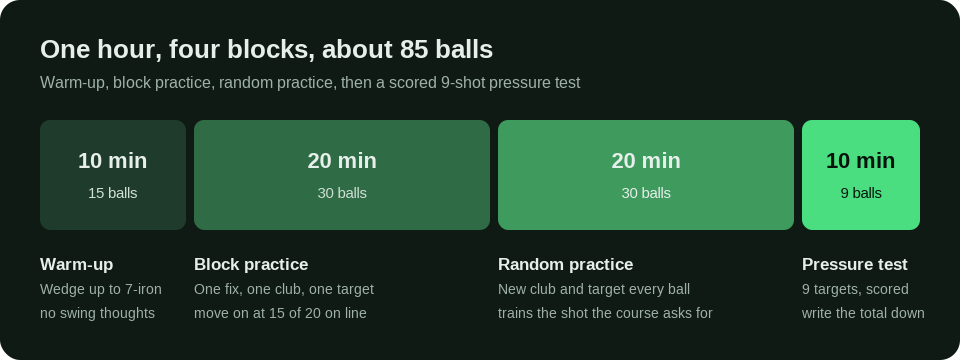
The 10/20/20/10 template uses about 85 balls, one large bucket. A second bucket is usually where the practice turns aimless.
When to change the split
- Fighting one miss (say, a two-way miss with the driver): go 30 minutes block, 10 random.
- Two weeks before a club championship or a golf trip: flip it to 10 block, 30 random, so you're practicing the shots the course will actually ask for.
Whatever split you use, write down what you worked on. The split only helps if next week's session starts from this one.
What does a range session with real targets look like?
Aimless bucket hitting means every ball has a different target, or none. Give every ball a job: a target, a club, and a note on the miss.
Block practice: one club, one shape, 30 balls
Pick one club and one shot shape. Hit at the same flag, say 120 yards, on the same start line. You're not scoring here; you're grooving the fix. When 15 of 20 in a row start on your line, move on.
If you own an AimBox, block practice is where it belongs. AimBox is a swing-path trainer, so it gives your block reps instant feedback on the path you're grooving.
Random practice: a new club and target every ball
In random practice, change club and target every ball: driver to the fence, 8-iron to the 150 sign, wedge to the 60-yard marker. Random practice feels worse and looks worse on the range, but random practice is what trains you to pick a club and commit on the course. Two 15-ball rounds are enough.
Notice three things on every ball
What separates practice from just hitting balls is noticing the miss. After each ball, note:
- Strike: toe, heel, thin or fat.
- Start line: left, right or on your line.
- Finish: where it ended up.
A ball that starts right and draws back to the flag needs a different fix than one that starts right and stays right, even though both "found the target." Three things per ball is plenty: a launch monitor can bury you in numbers, and most of them won't mean much by next week.
By the end of the hour you'll have noticed around 60 shots, and the pattern in those misses is your one fix for next time. Settle on it before you leave the parking lot. If you can't say what your misses were, you can't tell your coach, or yourself, what to work on next.
How do you fit in putting when the range has no room?
Most ranges give you a mat and a strip of grass, and the short-game area is a walk away. Keep the structure: take 10–15 minutes from random practice and putt before or after you hit balls. Set your stroke rhythm first with a free putting metronome: 74 BPM is a good starting tempo, and every putt in the block uses the same beat.
A 15-minute putting routine for the practice green
- Lag putting, 5 minutes. Three balls each from 30, 40 and 50 feet. Score every attempt as a make, a two-putt or a three-putt.
- Start line, 5 minutes. From 6 feet, roll putts until 10 in a row start on your line. An AimPutt makes this one obvious: its start-line rail shows whether the ball started where you aimed, and its pace rail and distance marks help with speed.
- Pressure, 5 minutes. Make 3 of 5 from 5 feet, or start the block over.
Follow your lag two-putt rate across sessions. If your lag two-putt rate is stuck below 70%, that's your fix for the next week.
If you use AimBox Golf AI, its putting tracker logs 10-putt sets from 3, 6 and 10 feet. The tracker gives your putting the same before-and-after number the pressure test gives your long game.
No green? A 30-yard wedge ladder
If there's no green at all, build one on the range. Pick a target 30 yards out and hit three wedges at it, then 50, then 70. Judge each ball by how close it lands to your spot, not by how it felt. The goal is a carry number you can trust on the course, because many wedge misses come from not knowing your distances. The wedge ladder takes time from random practice, so run it every other session.
How do you end with a pressure test that feels like the course?
The 9-shot "front nine"
Spend the last 10 minutes hitting nine shots at nine different targets, as if each were a tee shot or approach: a flag at 140, a gap between two trees at 165. Score every shot as fairway, green or miss, and write the total down before you leave.
Add a consequence
Make a miss cost something: 20 push-ups, a lap of the range, or starting the nine over. Block practice never punishes a bad shot, and the course always does. A test with a consequence is the cheapest way to practice that feeling.
Use the same test every session
Hit the same nine targets every session and you get one number that moves over weeks, instead of a vague impression. Range work only counts if it shows up in real rounds (your handicap is built from posted scores, per the USGA's World Handicap System), and the pressure test is your early warning of whether it will. If your score stalls while your ball-striking feels better, the next fix is transfer, not technique: shift more minutes to random practice.
How do you know if practice is transferring to the course?
Write down 3 things after each session
- Your miss pattern: left, right, fat or thin.
- The one fix you worked on.
- Your pressure-test score.
On the course, add fairways hit and your worst hole. That's the whole log.
Start each session where the last one ended
A fix only sticks if the next session starts from it, not from zero. Before your next bucket, reread last session's miss pattern and pick the drill that goes after it. Four weeks of sessions that build on each other beat four weeks of fresh starts, and session-to-session follow-up is how a 4-week plan actually forms: one fix, checked and adjusted, session after session.
Where a coach that remembers fits
You can keep this log in a notebook, or bring it to a lesson (here's what lessons cost in 2026). You can paste it into ChatGPT, which will explain one session well but won't remember last month's misses next time (here's the difference).
AimBox Golf AI is built for the gap between sessions. You tell it how practice went (out loud at the range with Range Mode, or by typing afterwards), it remembers your misses, and it gives you the one fix and drill for next time, then checks back. Pair it with AimBox for your swing path and AimPutt for your start line, and every session builds on the last.
Where AimBox Golf AI falls short: AimBox Golf AI doesn't read launch-monitor data or analyze swing video, and only knows what you tell it. If you want strike numbers or frame-by-frame review, you'll still need a launch monitor or a video app alongside it. AimBox Golf AI runs the practice plan; it doesn't replace measurement.
FAQ
How many balls should I hit in a 60-minute range session?
About 85: 15 to warm up, 30 for block practice, 30 for random practice and 9 for the pressure test. One large bucket covers it. A second bucket usually means the extra balls have no target, which turns practice back into just hitting balls.
Is it better to practice one club or rotate clubs?
Both, in that order. Use the block segment for one club and one shot shape until the fix sticks, then change club and target every ball in random practice. Rotating from the start doesn't let the fix settle; staying on one club all hour builds a swing that doesn't transfer to a course that asks for a different shot every time.
How long before this shows up in my scores?
Expect your pressure-test score to move within two or three sessions; it's your early signal. Your scorecard usually follows over about four weeks of one-fix-per-session practice. If your ball-striking feels better but your scores stall, the problem is transfer, so spend more of the hour on random practice.
What should my putting practice look like if I only have 15 minutes?
Five minutes of lag putting from 30–50 feet, five minutes of start-line work from 6 feet, and five minutes of pressure putts: make 3 of 5 from 5 feet. If you own an AimPutt, use it for the start-line block, where it helps most.